GRU的更新公式如下: \[ \begin{align*} z_t &= \sigma(W_{zh} \cdot h_{t-1} + W_{zx} \cdot x_t + b_z) \quad \text{(更新门)} \\ r_t &= \sigma(W_{rh} \cdot h_{t-1} + W_{rx} \cdot x_t + b_r) \quad \text{(重置门)} \\ \tilde{h}_t &= \text{tanh}(W_{hh} \cdot (r_t \odot h_{t-1}) + W_{hx} \cdot x_t + b_h) \quad \text{(候选隐藏状态)} \\ h_t &= (1 - z_t) \odot h_{t-1} + z_t \odot \tilde{h}_t \quad \text{(最终隐藏状态)} \end{align*} \]

从零实现

1
2
3
4
5
6
7
8
9
10
11
12
13
14
15
16
17
18
19
20
21
22
23
24
25
26
27
28
29
30
31
32
33
34
35
36
37
38
39
40
41
42
43
44
45
46
47
48
49
50
51
52
53
54
55
56
57
58
59
60
61
62
63
64
65
66
67
68
import torch
from torch import nn
from torch.nn import functional as F
from d2l import torch as d2l
import math


def get_params(vocab_size, num_hiddens, device):
input_size = output_size = vocab_size
def normal(shape):
return torch.randn(size=shape, device=device)*0.01

w_zh, w_zx, b_z = normal((num_hiddens, num_hiddens)), normal((input_size, num_hiddens)), torch.zeros((num_hiddens), device=device)
w_rh, w_rx, b_r = normal((num_hiddens, num_hiddens)), normal((input_size, num_hiddens)), torch.zeros((num_hiddens), device=device)
w_hh, w_hx, b_h = normal((num_hiddens, num_hiddens)), normal((input_size, num_hiddens)), torch.zeros((num_hiddens), device=device)
w_ho, b_o = normal((num_hiddens, output_size)), torch.zeros((output_size), device=device)
params = [w_zh, w_zx, b_z, w_rh, w_rx, b_r, w_hh, w_hx, b_h, w_ho, b_o]
for param in params:
param.requires_grad_(True)
return params


def init_state(batch_size, num_hiddens, device):
H = torch.zeros((batch_size, num_hiddens), device=device)
return (H, )

class GRU(object):
def __init__(self, vocab_size, num_hiddens, device):
self.vocab_size = vocab_size
self.params = get_params(vocab_size, num_hiddens, device)

def gru(self, inputs, state):
# inputs: (time_step, batch_size, vocab_size)
w_zh, w_zx, b_z, w_rh, w_rx, b_r, w_hh, w_hx, b_h, w_ho, b_o = self.params
H, = state

outputs = []
for X in inputs:
# Z, R 缩放到0-1
Z = torch.sigmoid((X @ w_zx) + (H @ w_zh) + b_z)
R = torch.sigmoid((X @ w_rx) + (H @ w_rh) + b_r)
H_hat = torch.tanh((X @ w_hx) + ((R * H) @ w_hh) + b_h)
H = Z * H + (1 - Z) * H_hat
Y = H @ w_ho + b_o
outputs.append(Y)
outputs = torch.stack(outputs, dim=0)
return outputs, H
def forward(self, X, state):
# 将H detach
for s in state:
s.detach_()
inputs = F.one_hot(X.T, self.vocab_size).type(torch.float32)
outputs, H = self.gru(inputs, state)
return outputs, (H, )
def __call__(self, *args) -> Any:
return self.forward(*args)

def predict(prefix, num_preds, net, vocab, device):
state = init_state(batch_size=1, num_hiddens=256, device=device)
outputs = [vocab[prefix[0]]]
get_input = lambda: torch.tensor([outputs[-1]], device=device).reshape((1, 1))
for y in prefix[1:]:
_,state = net(get_input(), state)
outputs.append(vocab[y])
for _ in range(num_preds): # 预测num_preds步
y, state = net(get_input(), state)
outputs.append(int(y.argmax(dim=2).reshape(1)))
return ''.join([vocab.idx_to_token[i] for i in outputs])

超参数与数据集:

1
2
3
4
5
6
7
8
9
10
11
12
13
14
15
16
17
batch_size = 32
# 一个时间步的长度
num_steps = 35
# vocab 是基于字母的标号
train_iter, vocab = d2l.load_data_time_machine(batch_size, num_steps)
vocab_size = len(vocab)

num_hiddens = 256
device= torch.device('cuda')
net = GRU(vocab_size, num_hiddens, device)
state = init_state(batch_size, num_hiddens, device)

num_epochs = 500
lr = 1
clip_value = 1.0
loss = nn.CrossEntropyLoss()
updater = torch.optim.SGD(net.params, lr=lr)
1
2
3
4
5
6
7
8
9
10
11
12
13
14
15
16
17
18
19
20
21
22
23
24
25
26
27
28
29
timer = d2l.Timer()
for epoch in range(num_epochs):
metric = d2l.Accumulator(2)
for x,y in train_iter:
x,y = x.to(device), y.T.to(device)
y_hat, state = net(x, state)
l = loss(y_hat.reshape(-1, vocab_size), y.reshape(-1).long()).mean()
updater.zero_grad()
l.backward()
nn.utils.clip_grad_norm_(net.params, clip_value)
updater.step()

metric.add(l * y.numel(), y.numel())
if epoch%100 == 0 and epoch!=0:
print('困惑度:', math.exp(metric[0] / metric[1]))
print(predict('time traveller ', 100, net, vocab, device))

math.exp(metric[0] / metric[1]), metric[1] / timer.stop()

# 输出
困惑度: 1.1065177855422412
time traveller for so it will be convenient to speak of himwas expounding a recondite matter to us his grey eyes sh
困惑度: 1.067931596405871
time traveller for so it will be convenient to speak of himwas expounding a recondite matter to us his grey eyes sh
困惑度: 1.079099433703705
time traveller with a slight accession ofcheerfulness really this is what is meant by the fourth dimensionthough so
困惑度: 1.0968159457665212
time traveller with a slight accession ofcheerfulness really this is what is meant by the fourth dimensionthough so
(1.0772619236579197, 46.92362845798529)
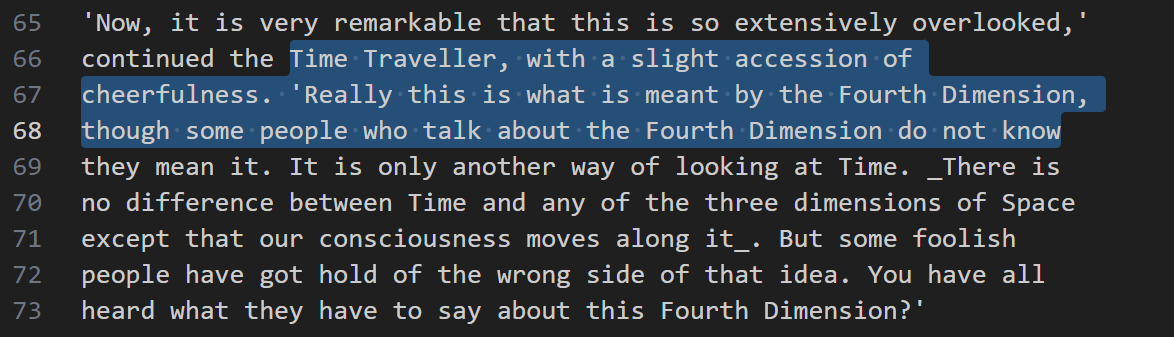
原文: 发现GRU背文章的能力不错!

疑问

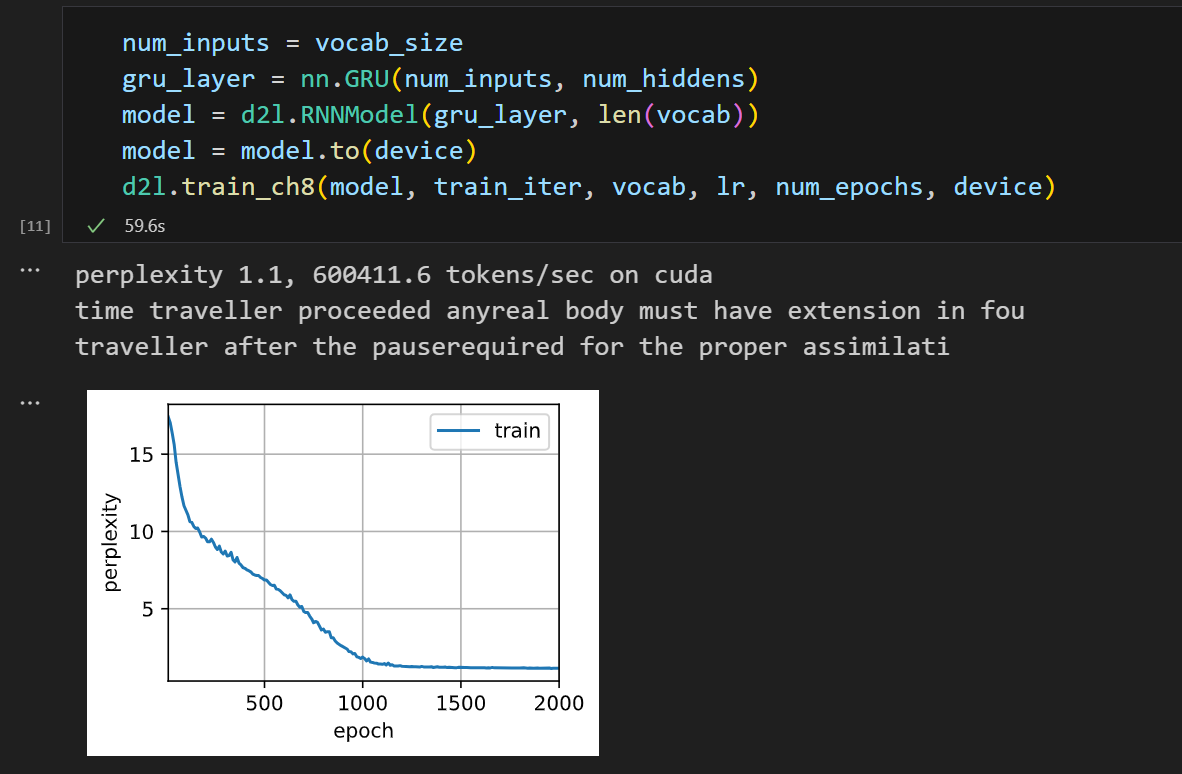
  • batch_size=128时效果差? 发现似乎是500个epoch未能使得收敛,将epoch置为2000时